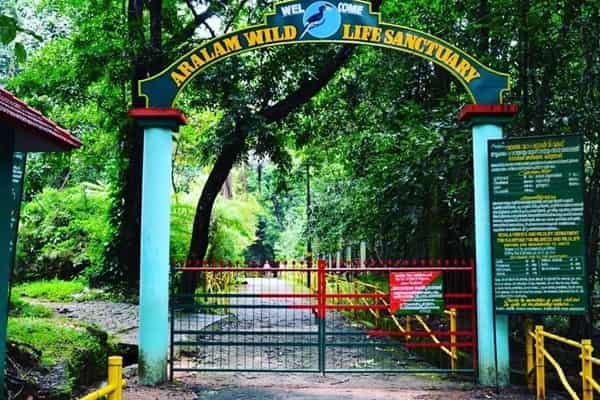
Aralam Wildlife Sanctuary is one of Kerala’s quieter Western Ghats reserves, and that relative calm is a large part of its appeal. Located in Kannur district near Iritty, the sanctuary protects about 55 sq km of forest ranging from moist deciduous stretches to semi-evergreen and evergreen habitat. It is also the only wildlife sanctuary in Kannur district, making it an important conservation area as well as a practical destination for travellers who want a forest experience without the scale or crowd levels associated with Kerala’s best-known tiger reserves.
The visitor experience at Aralam is strongly linked to walking and guided ecotourism. The entrance is at Valayamchal, from where day visitors can explore approved routes and book activities such as the Meenmutty trek. Butterflies are a major attraction here, especially during seasonal movements, while the forests also support elephants, gaur, sambar, spotted deer, barking deer, Nilgiri langur, Malabar giant squirrel and a varied bird population. Aralam works best for people who value a slow forest day, guided trekking and close observation of smaller forms of wildlife rather than a conventional vehicle safari.
Quick About Aralam Wildlife Sanctuary
| Detail | Information |
| Location | Aralam / Valayamchal, Kannur district, Kerala |
| Protected Area | Wildlife Sanctuary |
| Area | About 55 sq km |
| Year Established | 1984 |
| Main Entrance | Valayamchal |
| Known For | Western Ghats forest, butterflies, trekking and Meenmutty Falls |
| Nearest Town | Iritty |
| Nearest Major Railheads | Thalassery and Kannur |
| Best Period | November to May |
| Visit Style | Day visit and guided trekking |
Aralam Wildlife Sanctuary Timings
Kerala Tourism’s official ecotourism page lists the sanctuary as open throughout the year and gives the normal park operating hours as 8:00 AM to 4:00 PM. Guided trekking and other packages may have their own reporting times, and access can be restricted during heavy rain or for wildlife-management reasons.
| Visitor Activity | Timing | Important Note |
| General sanctuary visit | 8:00 AM to 4:00 PM | Day visitors should arrive early |
| Guided trekking | As allotted by forest staff | Advance confirmation is advisable |
| Camping / multi-day trek | Only with prior permission | Not a walk-in activity |
Kerala Tourism specifically advises confirming package availability because climate and other operational conditions can affect ecotourism programmes.
Aralam Wildlife Sanctuary Ticket Price
Kerala Tourism publishes separate charges for day visitors and some guided programmes. The figures below are the useful published reference rates, but package availability and tariff revisions should be confirmed before travel.
| Visitor / Activity | Published Charge |
| Indian adult day visitor | ₹115 |
| Indian child, 13 to 18 years | ₹40 |
| Indian child below 13 years | ₹10 |
| Foreign visitor | ₹360 |
| LMV vehicle entry | ₹110 |
| 3-hour trek | ₹500 for minimum 5 persons |
| Additional person on 3-hour trek | ₹60, up to the permitted group limit |
| 6-hour trek | ₹800 for minimum 5 persons |
The Meenmutty experience involves a jeep and guide arrangement, while longer Ambalappara trekking or camping needs prior permission. Do not assume every package is available every day.
What to See and Do at Aralam Wildlife Sanctuary
Aralam is a landscape to explore rather than a single viewpoint. The forests rise towards the Western Ghats, and the sanctuary’s varied elevation creates changes in vegetation, birdlife and walking conditions. The official ecotourism programme highlights the route towards Meenmutty Falls, where visitors travel part of the way by jeep and continue with a guided nature experience.
Meenmutty Falls: This is one of the best-known day experiences. The route combines forest travel, a watchtower stop and a waterfall visit, making it suitable for visitors who want more than a short entrance-area walk.
Pothenplavu Watchtower: The watchtower gives a wider view over the forest canopy and the Western Ghats. Patient visitors may also pick up hornbills, minivets and other birds from the elevated vantage point.
Butterfly watching: Aralam is especially well known for butterflies. Seasonal butterfly movement can be one of the sanctuary’s most rewarding natural events, and slower walking produces far better observations than rushing along the trail.
Ambalappara trekking: This is a more demanding option that can extend into a multi-day experience. It requires planning, guides and permission rather than spontaneous entry.
Forest birding: The mix of forest types supports hornbills, woodland birds and many smaller species. Early morning is the best time to listen for calls before daytime heat builds.
Wildlife and Habitat
The sanctuary’s forest types include West Coast semi-evergreen forest, tropical evergreen forest, moist deciduous forest and higher-elevation evergreen formations. This ecological variety is why Aralam can support both large mammals and an unusually rich insect and bird community.
Elephants, gaur, sambar, spotted deer, barking deer, Nilgiri langur, Hanuman langur and Malabar giant squirrel are among the animals associated with the sanctuary. Sightings depend on season, trail, time and luck. Aralam is not a zoo and should never be described as a place where visitors can reliably see a particular animal.
How To Reach Aralam Wildlife Sanctuary
By Road
Iritty is the most useful nearby town. From Iritty, continue towards Aralam and Valayamchal by taxi, private vehicle or local transport. Kerala Tourism notes that using one’s own vehicle can be convenient because the sanctuary is away from major town limits.
By Train
Thalassery and Kannur are the practical railheads. Kerala Tourism lists Thalassery at roughly 55 km from the sanctuary. From the station, the remainder of the journey is by road through Iritty.
By Air
Kannur International Airport is the closest major airport in practical terms, even though older tourism material sometimes lists Kozhikode. From the airport, road travel through Mattannur and Iritty is the simplest option.
At the Entrance
Valayamchal is the main visitor entrance. Vehicle parking and forest-related arrangements are handled here, so visitors with a booked trek should reach early enough for registration and instructions.
Best Time to Visit Aralam Wildlife Sanctuary
Kerala Tourism recommends November to May, although the sanctuary remains open throughout the year. November to February is especially pleasant for walking because temperatures are more comfortable and rainfall is lower. This period also suits birdwatchers and butterfly enthusiasts.
March to May becomes warmer but can still be rewarding, particularly in the morning. The southwest monsoon transforms the forest into an intensely green landscape, but heavy rain can make streams, roads and trails unsafe. Activities may be modified or temporarily stopped during severe weather, so a monsoon visit should always be confirmed with the sanctuary office.
How Much Time to Keep for the Visit
A simple day visit needs at least three to four hours if you want time for forest observation rather than only reaching the entrance and returning. The Meenmutty programme can take a substantial part of the day. Longer trekking routes should be treated as dedicated experiences, not squeezed into a rushed sightseeing schedule.
Visitor Facilities and Practical Tips
Book longer activities in advance: Camping and multi-day trekking depend on permission, guides and available capacity.
Carry suitable footwear: Forest trails can be muddy, rocky or wet. Closed walking shoes are preferable.
Take insect protection: Leeches and mosquitoes can be more noticeable in wet conditions; simple protective clothing helps.
Keep water and a light snack: Do not depend on finding shops once you are on a guided interior route.
Use binoculars: Aralam’s birds and butterflies reward slow observation; binoculars add more value than trying to approach wildlife.
Respect guide instructions: Guides know which stretches are safe and whether elephants or other wildlife have recently moved through an area.
Important Rules for Visitors
Do not leave the approved route, separate from the group or approach wild animals. Forest staff may change a programme because of elephant movement, weather or damaged trails. Such changes are safety decisions, not service failures.
Plastic waste, loud music, alcohol, smoking and feeding wildlife are inappropriate inside the sanctuary. Photography should not involve chasing animals or blocking their movement. If an elephant or other large animal is seen, follow the guide’s instructions immediately and quietly.
FAQs About Aralam Wildlife Sanctuary
Q. Is Aralam suitable for first-time trekkers?
Yes, if you choose the shorter guided programme and are reasonably comfortable walking on natural terrain. The longer Ambalappara routes are better for people with trekking experience and more time.
Q. Can senior citizens visit Aralam without doing a long trek?
A basic visit is possible, but the best-known experiences involve uneven forest terrain. Senior visitors should discuss the day’s easiest available option with staff at Valayamchal rather than booking a demanding trek by default.
Q. Do I need my own vehicle inside the sanctuary?
Private transport is useful for reaching Valayamchal, while specific ecotourism activities may use authorised jeeps or guided routes. Whether a private vehicle can proceed beyond a particular point depends on the programme and current rules.
Q. Is Aralam good for butterfly photography?
Yes. The sanctuary is known for butterfly diversity and seasonal movement. A macro or medium telephoto lens, quiet behaviour and slow walking can produce better results than searching only for large mammals.
Q. Can visitors stay overnight inside Aralam?
Overnight nature camps and longer trekking programmes exist, but they are permission-based and capacity-limited. They should be arranged in advance rather than assumed to be available on arrival.
Q. Is mobile connectivity reliable on the trekking routes?
Do not depend on continuous signal once you move into the forest. Share your plan with family beforehand and follow the guide rather than using phone navigation as the primary way to move through the sanctuary.