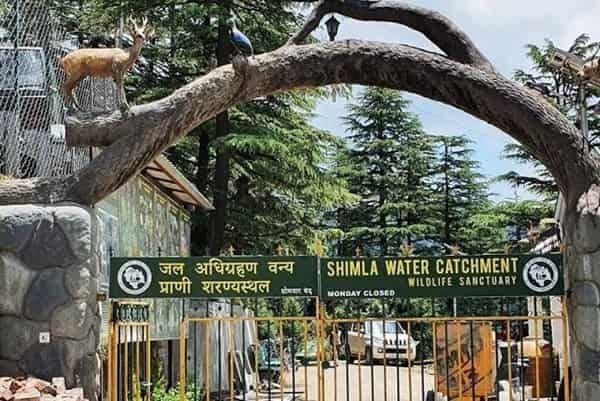
Shimla Water Catchment Wildlife Sanctuary is a rare protected forest where conservation history, city water security and nature tourism all meet in one landscape. Spread over roughly 10.2 sq km on the eastern side of Shimla, the sanctuary protects dense Himalayan forest above Dhalli and Charabra and contains the historic catchment system that supplied water to the hill station through gravity-fed channels and perennial streams. Unlike a conventional safari park, the experience here is built around a long forest trail, walking, cycling and guided nature observation.
The main visitor route runs from the Dhalli side towards Seog through oak, cedar, pine and mixed temperate forest. The current management plan identifies a roughly 7 km jeepable trail as the core eco-tourism corridor and proposes guided nature walks, cycling, birdwatching and low-emission transport rather than heavy vehicle tourism. The forest supports goral, barking deer, langur, rhesus macaque, porcupine, martens and elusive predators such as leopard, while its birdlife is one of the strongest reasons to visit quietly.
For readers planning a Shimla trip, this sanctuary offers something very different from the crowded Ridge-Mall Road circuit. It works best as a half-day forest escape where the point is not to ‘cover’ attractions but to spend time inside a mature Himalayan woodland. The route is long enough to feel immersive, yet close enough to Shimla to fit easily into a two- or three-day city itinerary.
Quick About Shimla Water Catchment Wildlife Sanctuary
| Detail | Information |
| Location | Dhalli-Charabra-Seog area, Shimla district, Himachal Pradesh |
| Protected Area | Wildlife Sanctuary |
| Gazetted Area | About 10.2 sq km |
| Forest Character | Temperate oak, conifer and mixed Himalayan forest |
| Known For | Forest trail, birdwatching, cycling and historic water catchment |
| Main Visitor Trail | Dhalli/entry side to Seog, about 7 km one way |
| Nearest Major Town | Shimla |
| Nearest Railway Station | Shimla |
| Nearest Airport | Shimla Airport at Jubbarhatti |
| Best General Period | March-June and September-November |
Shimla Water Catchment Wildlife Sanctuary Timings
The commonly used visitor schedule is around 10:00 AM to 4:00 PM, with Monday generally treated as the weekly closure. The Forest Department’s current management plan emphasises regulated visitor numbers, permits and monitored eco-tourism, so the gate can apply operational restrictions even when the broader schedule is unchanged.
| Day / Visit | Timing | Planning Note |
| Tuesday to Sunday | Around 10:00 AM to 4:00 PM | Common visitor schedule; confirm before travel |
| Monday | Usually closed | Forest-management closure |
| Full trail outing | Start near opening | Allow enough time for the return journey |
Snow, heavy rain, forest operations or wildlife movement can affect access. Because the main trail is long, do not begin a complete out-and-back walk close to closing time.
Shimla Water Catchment Wildlife Sanctuary Ticket Price
Himachal Pradesh revised wildlife-sanctuary fees in June 2026. The notified statewide entry structure raised the standard Indian visitor charge to ₹300 and the foreign visitor charge to ₹600. Sanctuary-specific rentals, guided activities or vehicle permissions can be additional.
| Visitor / Service | Current Reference Charge |
| Indian visitor | ₹300 per day under 2026 wildlife-sanctuary rules |
| Foreign visitor | ₹600 per day under 2026 rules |
| Cycle / equipment rental | Separate, if available |
| Guide / low-emission vehicle | Separate and subject to local operation |
Older travel pages still show much lower entry figures from previous years. Use the current Forest Department rate at the gate if it differs from any older online listing.
What Makes the Sanctuary Different
The forest was protected not only for wildlife but also because it forms a catchment above Shimla. Nine perennial streams are described in older and current management material, and the area’s century-old water-harvesting infrastructure is an important part of the city’s environmental history. This water function explains why forest protection here has always been especially strict.
For tourists, the result is a landscape with very little commercial clutter once the trail begins. There are no rows of shops or amusement facilities inside. The quiet forest, bridges, stream crossings and changing light through oak and conifer canopy are the attraction.
Wildlife, Birds and Forest Habitat
The sanctuary supports Himalayan mammals such as goral, barking deer, langur, rhesus macaque, porcupine and small carnivores. Leopard also occurs, but ordinary daytime visitors should not expect to see one. Wildlife observation is more realistically based on tracks, calls, fleeting deer sightings and bird activity.
Birdwatching can be excellent because the forest provides multiple layers of habitat. Magpies, woodpeckers, thrushes, tits, flycatchers, raptors and other Himalayan species occur depending on season and elevation. Early in the visitor day, quiet groups usually hear much more than large, noisy groups.
Best Things to Do
- Walk the Dhalli-Seog forest trail: This is the core experience. The route is gradual enough for many reasonably fit visitors but long enough that the return distance must be considered.
- Cycle through the catchment: Cycling has been identified as a suitable low-impact eco-tourism activity. Availability and rental condition should be checked at the entrance.
- Birdwatch quietly: The sanctuary is much more rewarding with binoculars. Stop periodically instead of treating the route as a fitness race.
- Study the water-catchment landscape: Old channels, streams and forest hydrology explain why this small sanctuary is so important to Shimla.
- Use guided nature interpretation: A trained guide can explain plants, water systems, animal signs and forest management in a way that a simple walk cannot.
How To Reach Shimla Water Catchment Wildlife Sanctuary
From Shimla
The sanctuary entrance is on the eastern side of the city near Dhalli/Charabra, roughly 8-10 km from central Shimla depending on the starting point. A taxi is the easiest option because it allows an early arrival and a planned pickup after the walk.
By Train
Shimla Railway Station is the nearest railhead and connects with Kalka through the heritage narrow-gauge line. From the station, take a taxi towards Dhalli and the sanctuary entrance.
By Air
Shimla Airport at Jubbarhatti is the closest airport, though flight schedules can be limited. Chandigarh is a more practical air gateway for many travellers, followed by a road journey to Shimla.
Local Transport
Buses run towards Dhalli and Kufri-side routes, but visitors planning the full forest trail may prefer a taxi so they are not dependent on infrequent return transport.
Best Time to Visit Shimla Water Catchment Wildlife Sanctuary
March to June is excellent for comfortable walking, flowering vegetation and active birdlife. Temperatures are much more pleasant than on the plains, though late May and June can be busier around Shimla. September to November is another strong period, with clearer skies after the monsoon and crisp forest conditions.
Winter creates a beautiful atmosphere and occasional snow can completely transform the trail, but ice, cold and short daylight can make a full walk more demanding. July and August bring heavy monsoon rain and slippery surfaces. If walking rather than merely visiting the gate area, always check the forecast first.
How Much Time to Keep for the Visit
A short forest visit needs around two hours, but visitors who want to cover a substantial part of the main trail should keep three to four hours. A complete relaxed walk towards Seog and back can take longer depending on fitness, photography stops and whether a cycle is used.
Visitor Facilities and Practical Tips
- Carry water and snacks: Once inside, do not expect regular food stalls. Carry what you need and take all waste back out.
- Wear proper walking shoes: The trail may look easy near the entrance but becomes tiring over a long distance.
- Take a light jacket: Forest shade and hill weather can feel much cooler than central Shimla.
- Keep rain protection: Mountain weather can change quickly, especially around the monsoon shoulder season.
- Do not rely only on phone signal: Download essential information before entering and stay on the permitted route.
- Start early enough for the return: The outward walk can feel deceptively easy; save time and energy for the return to the gate.
Important Rules for Visitors
The catchment is both wildlife habitat and a sensitive water-supply forest. Do not litter, enter streams, damage vegetation or leave the designated trail. Loud music, smoking and fire are inappropriate and can create serious forest risk.
Wild animals should never be approached or fed. If a guide or forest employee asks visitors to turn back because of wildlife activity or weather, follow the instruction immediately.
FAQs About Shimla Water Catchment Wildlife Sanctuary
Q. Is the sanctuary suitable for people who do not want a strenuous trek?
Yes. Visitors can walk only part of the main trail and return. There is no requirement to cover the entire Dhalli-Seog route to enjoy the forest.
Q. Can children cycle inside the sanctuary?
Cycling may be available as an eco-tourism activity, but suitability depends on the child’s experience, cycle availability and trail condition. A long out-and-back ride can be tiring for younger children.
Q. Are leopard sightings common?
No. Leopards occur in the landscape but are secretive. A normal daytime visitor is far more likely to see birds, monkeys or signs of smaller wildlife than a leopard.
Q. Can the sanctuary be visited during snowfall?
Access may be possible when conditions are safe, but snow and ice can close or restrict the trail. Confirm locally before travelling specifically for a snow walk.
Q. Is there a restaurant inside the sanctuary?
Do not plan on regular food service inside the forest. Carry a modest amount of food and water, but keep it packed securely and take all waste out.
Q. Why is visitor movement regulated so closely?
The area is small, ecologically sensitive and historically important as Shimla’s water catchment. Limiting noise, vehicles and visitor density protects both wildlife and water resources.